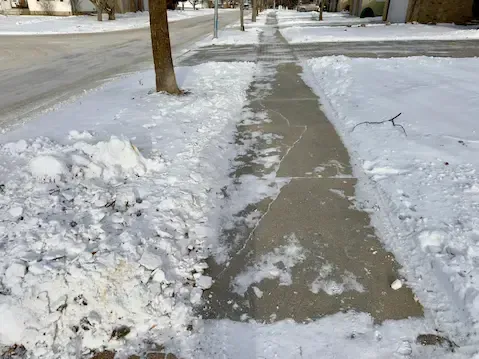
Cedar Falls Sidewalk Clearing Schedule Through Winter
Winter in Cedar Falls is not a single event — it is a sustained stretch of cold, snow, and ice that runs from late November through March and sometimes into April. For homeowners and businesses along public walkways, that means sidewalk maintenance is not a one-time task. It is a recurring responsibility tied directly to weather patterns, municipal ordinances, and the safety of every neighbor, delivery worker, and pedestrian who passes your property. Understanding how a professional sidewalk clearing schedule works through an Iowa winter helps you plan ahead, stay compliant, and avoid the gaps that lead to injuries or citations.
How a Seasonal Sidewalk Clearing Schedule Is Built
A well-designed winter schedule is not built around calendar dates. It is built around snowfall triggers. A trigger is a threshold — typically one to two inches of accumulation — at which service automatically activates. This matters in Cedar Falls because weather here does not follow predictable weekly patterns. You can go ten days with nothing, then get three consecutive snowfall events back to back. A trigger-based schedule means crews are dispatched whenever conditions meet the threshold, not on a fixed Tuesday rotation that may miss a Sunday storm entirely.
At the start of the season, routes are mapped across service zones in Cedar Falls. Neighborhoods like College Hill, Prospect Heights, and the streets surrounding UNI see heavy pedestrian traffic and require priority sequencing. Routes are finalized before the first measurable snow so that when a storm arrives at two in the morning, there is no guesswork about where crews go first.
What the Schedule Looks Like Month by Month
November marks the beginning of active monitoring. Early-season snow in Cedar Falls is often wet and heavy, packing into ice quickly when temperatures drop overnight. Crews begin pre-season equipment checks and route confirmations during this window. Any service agreements signed in October or early November are active from this point forward.
December through February is the core of the schedule. This is when the majority of Cedar Falls snowfall accumulates and when back-to-back events are most common. During this period, response time is measured from the point snowfall ends or reaches the trigger threshold — not from sunrise. Overnight and early morning events are handled before the typical workday begins, so sidewalks are cleared before morning foot traffic peaks.
March is a transition month. Snow events are still common but temperatures fluctuate, meaning melt-and-refreeze cycles create icy surfaces even when no new snow is falling. The schedule stays active through March and monitoring continues until sustained temperatures eliminate overnight freeze risk. Deicing applications become more important during this window than straight plowing.
Why Timing Matters for Cedar Falls Property Owners
Cedar Falls city ordinance requires property owners to clear adjacent sidewalks within a defined window after snowfall ends. Missing that window does not just create a hazard — it creates liability exposure and potential fines. When your clearing is handled through a scheduled service, compliance is built into the process rather than left to your own availability during a busy morning or a weekend storm.
Beyond compliance, timing matters for pedestrian safety in a practical sense. The neighborhoods around Cedar Falls schools, commercial corridors along University Avenue, and residential streets with bus stops see foot traffic regardless of conditions. An uncleared sidewalk forces pedestrians into the street, creates fall risk for older residents, and signals neglect to anyone passing the property.
If you want to understand more about how professional clearing is structured across different parts of the city, our sidewalk clearing overview walks through how neighborhood routes are organized and what residents can expect from a managed service.
What Happens Between Snowfall Events
A clearing schedule does not go dormant between storms. Crews monitor for ice formation caused by temperature swings, track overnight forecast windows, and apply deicing material when conditions warrant. Cedar Falls winters frequently produce a pattern where afternoon sun softens snow near the surface and overnight temperatures refreeze that moisture into a solid sheet. This secondary icing is responsible for a significant portion of winter slip-and-fall incidents, and it requires a proactive response rather than a reactive one.
Sand and salt applications are worked into the schedule as a supplement to mechanical clearing. The specific materials used depend on temperature. Standard rock salt becomes ineffective below roughly fifteen degrees Fahrenheit, so at lower temperatures a treated salt blend or sand mix is applied to maintain traction where chemical melting is not feasible.
Signing Up and Setting Expectations
Getting onto a seasonal clearing schedule in Cedar Falls is straightforward, but timing matters. Routes fill as the season approaches, and properties added late may face limited availability for early November events. The earlier a service agreement is in place, the more reliably your property is integrated into route sequencing from day one of the season.
When you review a service agreement, pay attention to what the trigger threshold is, what the response window looks like after a storm ends, and whether deicing is included or priced separately. These details define the actual level of service you are receiving, not just during a standard six-inch storm but during the marginal events — a half-inch of ice, a dusting that refreezes overnight — that create the most risk without looking dramatic from the window.
For complete information on scheduling and what a full-season program includes, visit the Sidewalk Snow Clearing service page to see coverage details and contact options for Cedar Falls properties.
Planning for the Whole Season, Not Just the Next Storm
The most common mistake Cedar Falls property owners make is treating sidewalk clearing as a reactive task — something to handle after a storm arrives rather than a system put in place before the season begins. By the time a storm is in the forecast, route capacity may be limited and service quality in reactive bookings rarely matches what a planned seasonal client receives. The schedule works best when it is comprehensive, running from November through March without interruption, with consistent crews who know your property and its specific clearing requirements.
Winter along the Cedar River corridor is predictable in one way: it will show up, repeatedly, on its own timeline. A clearing schedule built around that reality keeps your sidewalks accessible, your liability managed, and your neighbors safe across every inch of the season.
