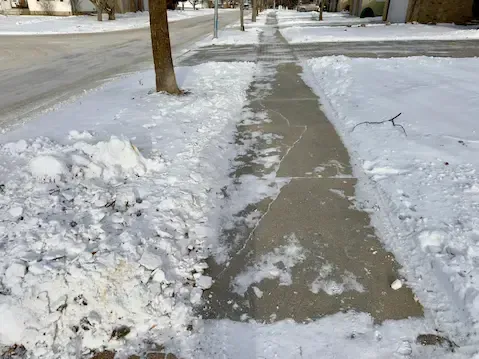
Sidewalk Snow Clearing in Cedar Falls Iowa Neighborhoods
When a winter storm moves through Cedar Falls, sidewalks across every neighborhood become buried under inches of snow and compacted ice. For homeowners, landlords, and business operators, that accumulation is more than an inconvenience — it creates real liability, restricts access for pedestrians of all abilities, and in many cases puts you in direct conflict with local ordinance requirements. Understanding what sidewalk snow clearing in Cedar Falls actually involves, what the city expects from property owners, and how to stay ahead of dangerous conditions will save you headaches all winter long.
Why Sidewalk Snow Clearing Matters More Than Most Property Owners Realize
It is easy to focus entirely on clearing your driveway and assume the sidewalk will handle itself or that someone else will take care of it. In practice, that assumption creates problems on multiple fronts. Cedar Falls sidewalks serve as the primary pedestrian travel path for residents walking to school, to bus stops, to neighboring properties, and through residential blocks. When those walkways stay buried after a storm, foot traffic shifts to the street itself, creating dangerous interactions between pedestrians and vehicles that have their own winter traction challenges.
Beyond the safety dimension, sidewalk clearing is a legal obligation in most Cedar Falls neighborhoods. The city of Cedar Falls follows standard Iowa municipal practices that place responsibility for sidewalk maintenance directly on adjacent property owners. That means the stretch of sidewalk running in front of your home or rental property is your responsibility to clear after a snowfall event — not the city's, not the county's, and not a problem you can defer indefinitely. Failing to comply after a reasonable window of time can result in fines or the city performing the clearing and billing you for the cost.
What the City Ordinance Requires and How Timing Works
Cedar Falls ordinance requires property owners to clear sidewalks within a defined period after snowfall stops. While exact hours can be updated by the city, the standard expectation across Iowa municipalities is that sidewalks must be cleared within 24 hours of the conclusion of a storm event. If a storm ends at midnight, you typically have until midnight the following day to have the sidewalk reasonably clear and passable.
What counts as compliant clearing? The standard is a passable path, not necessarily a perfectly bare concrete surface. During a heavy Iowa winter storm, a reasonable path that allows pedestrians to walk without stepping into deep snow satisfies the basic requirement. However, the safest and most liability-conscious approach is to remove snow down to the pavement surface and apply a de-icing material or sand to manage any ice that forms underneath or on top of packed snow.
One timing nuance that Cedar Falls property owners frequently overlook is what happens during multi-day storm events. When snow falls, partially melts, and then temperatures drop overnight, what was passable becomes an icy slab that is actually more dangerous than fresh powder. Those freeze-thaw cycles are common in Black Hawk County winters, and staying ahead of them requires clearing snow promptly rather than waiting for the full storm pattern to pass.
Residential Neighborhoods and the Specific Challenges They Create
Cedar Falls neighborhoods like College Hill, the Historic District near downtown, and newer residential developments along the city's outer edges each present different sidewalk clearing challenges. Older neighborhoods often feature concrete sidewalk panels that have shifted and cracked over decades, creating uneven surfaces where snow compacts into the gaps and ice forms at unpredictable angles. Newer developments may have longer continuous runs of sidewalk that require more time and equipment to clear efficiently.
Corner lots present a particular challenge in Cedar Falls residential areas. Homeowners on corner lots are responsible for the sidewalk along both street frontages, which can easily double or triple the total linear footage that needs to be cleared. The area where two sidewalk runs meet at a corner also tends to accumulate plow drift from city street plowing operations — the city maintains its roads, but snow that gets pushed to the curb line often lands directly on adjacent sidewalk corners.
Rental properties throughout Cedar Falls introduce additional complexity. Landlords are typically responsible for sidewalk clearing unless a lease agreement explicitly transfers that duty to the tenant. Even when leases include such language, enforcement is uneven and the city holds the property owner accountable if the sidewalk remains uncleared. Property managers handling multiple Cedar Falls rental units benefit significantly from a consistent Sidewalk Snow Clearing service that handles every property on a reliable schedule after each storm.
Tools, Materials, and What Actually Works in Iowa Winters
Not all snow removal approaches perform equally in Black Hawk County conditions. Cedar Falls winters regularly produce a mix of dry fluffy snow, wet heavy snow, and freezing rain events, and the right tool for one type of precipitation is often the wrong choice for another.
For light dry snow, a quality plastic-bladed snow shovel or a snow pusher with a wide blade moves large volumes quickly without excessive effort. For the wet, dense snow that Cedar Falls receives during warming events in January and February, a metal-bladed shovel with leverage-friendly ergonomics reduces the back strain that sends people to the chiropractor every winter. Snow blowers — either single-stage electric or two-stage gas — handle both types efficiently for homeowners willing to invest in the equipment and maintain it throughout the season.
De-icing materials matter as much as removal method. Rock salt is the most common choice and remains effective down to around 15 degrees Fahrenheit, which covers a wide range of Cedar Falls winter temperatures. Below that threshold, calcium chloride products perform better. Magnesium chloride is a less corrosive alternative that works in similar temperature ranges. For areas where concrete or plantings are a concern, sand provides traction without the chemical impact, though it does not melt ice and needs to be swept up once conditions improve.
One significant mistake Cedar Falls property owners make is applying de-icer after ice has already formed rather than before a storm. Pre-treating with ice melt before temperatures drop prevents bond formation between ice and pavement, making post-storm clearing dramatically easier and faster.
Common Mistakes That Lead to Injuries and Liability Claims
Sidewalk injury claims in Iowa follow a consistent pattern. The same preventable mistakes show up repeatedly in situations where pedestrians slip, fall, and sustain injuries on residential and commercial walkways throughout Cedar Falls.
The first and most common mistake is waiting too long to clear. Property owners often watch the forecast and wait to see if more snow is coming before they start shoveling. That delay allows foot traffic to compact what has fallen into a dense layer that is far harder to remove and far more slippery than fresh snow. Act early, even if you expect additional snowfall.
The second mistake is clearing only part of the sidewalk run. Clearing three-quarters of your sidewalk does not reduce your liability for the quarter you skipped. The entire accessible path needs to be clear, including the transition areas at driveways and curb cuts.
The third mistake is ignoring the sidewalk after what appears to be a minor event. Even a half-inch of freezing drizzle on Cedar Falls sidewalks creates conditions far more dangerous than several inches of dry snow. Black ice forms quickly and is invisible until someone is already on the ground. For anyone interested in understanding how driveways and sidewalk approaches interact with winter maintenance decisions, our post on driveway apron damage prevention explains how those two clearing zones connect and affect each other.
When Professional Service Makes Practical Sense
Not every Cedar Falls homeowner is physically able to clear sidewalks after every storm. Older residents, individuals recovering from injury or surgery, and families where every adult works long hours frequently find that committing to consistent manual clearing throughout a Black Hawk County winter is simply not feasible. For rental property owners managing multiple addresses across Cedar Falls — in neighborhoods from Viking Court to the areas around the University of Northern Iowa — trying to personally manage every sidewalk clearing run after each storm is a logistical impossibility.
Professional snow clearing services offer route-based contracts that cover your property after every qualifying snowfall event throughout the season. Reputable services in Cedar Falls establish trigger depths — for example, service begins when accumulation reaches two inches — and clear within a specified window after snowfall stops. That consistency protects you from ordinance violations, keeps tenants satisfied, and removes the liability exposure that comes with unpredictable or incomplete clearing.
When evaluating services, ask specifically how they handle the freeze-thaw cycle events that Cedar Falls experiences regularly. A service that clears after snowfall but does not revisit after overnight refreezing leaves you partially exposed. The best operators build return visits or ice treatment applications into their standard process rather than treating them as add-on events.
Keeping Cedar Falls Walkways Functional All Winter
Sidewalk snow clearing in Cedar Falls is not a task that fits neatly into one storm-by-storm decision. It requires a consistent approach that accounts for ordinance requirements, the specific challenges of your property layout, the range of winter precipitation types Black Hawk County delivers each season, and the realistic window you have available for clearing before conditions worsen or complaints arise.
Whether you handle clearing personally with the right equipment and materials or bring in a professional service to manage it reliably, the core goal is the same: keeping Cedar Falls pedestrians safe, keeping your property compliant, and ensuring that your sidewalks function as a usable part of the neighborhood's walkable infrastructure from the first snowfall of the season to the final thaw of spring.
