Cedar Falls Sidewalk Snow Ordinance Rules for Owners
If you own property in Cedar Falls, Iowa, keeping the adjacent sidewalk clear after a snowstorm is not optional. The city enforces a sidewalk snow ordinance that places direct responsibility on property owners, and failing to meet the timeline can result in fines or city-contracted removal billed to your account. Understanding exactly what the ordinance requires helps you plan ahead rather than scramble after every storm.
What the Cedar Falls Sidewalk Snow Ordinance Requires
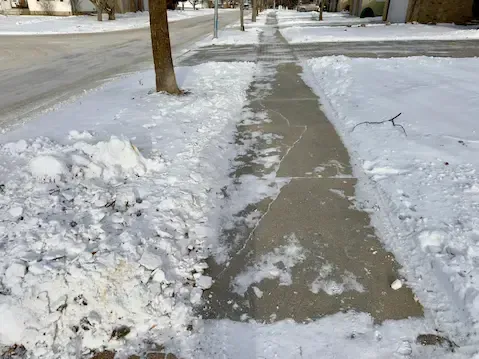
Cedar Falls municipal code requires property owners to clear snow and ice from public sidewalks abutting their property within a set window after a snowfall ends. The standard requirement is that sidewalks be cleared within 24 hours after a storm concludes. This applies to residential and commercial properties alike. The cleared path must be of sufficient width for pedestrians to walk safely, and simply salting without shoveling is generally not considered compliant when substantial accumulation is present.
The ordinance covers more than just fresh snow. If ice has accumulated or refreezing has occurred, property owners are still responsible for making the surface reasonably passable. Applying ice melt or sand to icy surfaces is part of your responsibility when temperatures keep the sidewalk from clearing on its own.
Who Is Responsible When Property Changes Hands or Is Rented
A common source of confusion in Cedar Falls involves rental properties and recently sold homes. As a general rule, the legal obligation rests with the property owner of record, not the tenant, unless a lease agreement explicitly transfers that duty. If you own a rental home in the Prospect Boulevard corridor, the Villages neighborhood, or anywhere else in Cedar Falls, you remain liable under the ordinance even if a tenant occupies the home.
If you have a lease clause assigning sidewalk clearing to a tenant, that is an arrangement between private parties. The city will still hold the property owner accountable if the sidewalk goes uncleared. For landlords managing multiple Cedar Falls properties, that is a meaningful operational detail worth reviewing with your tenants before winter begins.
Fines, Enforcement, and City Removal
When a sidewalk remains uncleared past the 24-hour window, the city may issue a notice of violation. If the violation continues, Cedar Falls has the authority to arrange removal through a city contractor and bill the cost directly to the property owner. That bill can be attached as a lien to the property if unpaid.
Fines vary and can compound if the problem is recurring within a single season. The city does prioritize complaint-based enforcement in many cases, meaning a neighbor or pedestrian report can trigger an inspection. High-traffic areas near Cedar Falls schools, parks, and commercial districts tend to draw more scrutiny, but residential side streets are not exempt.
Practical Challenges Cedar Falls Owners Face Every Winter
Black ice is a recurring problem in Cedar Falls, particularly during the freeze-thaw cycles common from late November through early March. A sidewalk that looks clear at noon can become a hazard by evening when temperatures drop again. Keeping a bag of ice melt near the door and checking sidewalk conditions after dark is a reasonable precaution.
Corner lots present an additional burden. If your property sits at an intersection in Cedar Falls, you are typically responsible for clearing the full sidewalk perimeter of your lot, which can be significantly more linear footage than a mid-block home. Some corner-lot owners in Cedar Falls underestimate this obligation and clear only the front sidewalk while leaving the side section untouched.
Storm timing also matters. A storm that ends late Sunday night still starts the 24-hour clock running. If you are traveling or otherwise away from the property, you need an arrangement in place before the storm hits, not after.
Common Misconceptions About the Ordinance
Several misunderstandings come up repeatedly among Cedar Falls homeowners. The first is that heavy snowfall or unusual storms create an exemption. They generally do not. The ordinance timeline is set after the storm concludes, so an unusually large accumulation still requires clearing within the same window.
Another misconception is that clearing a narrow single-file path satisfies the requirement. The intent of the ordinance is to restore usable pedestrian access, which typically means a path wide enough for normal foot traffic, not a single shovel-width channel. If you are unsure whether your clearing effort is adequate, erring toward clearing more of the width is the safer approach.
Some residents believe that if snow blows back onto the sidewalk from drifting after clearing, they are off the hook. The practical enforcement reality is that you may still receive a complaint if the sidewalk is impassable, regardless of cause. A second clearing pass or an application of melt product may be necessary.
Planning Ahead as a Property Owner in Cedar Falls
The most effective strategy is preparation before the season starts. Stock up on ice melt before early November, when Cedar Falls hardware stores can run low after the first cold snap. Know where your snow tools are. If you have a long driveway apron that the city plow typically fills back in after clearing the street, factor that into your clearing plan as well.
If you own property in Cedar Falls but cannot reliably clear it yourself due to travel, age, or physical limitations, arranging professional help is a sound investment. Sidewalk Snow Clearing services can be contracted on a seasonal or per-event basis, depending on your needs. Having that arrangement confirmed before snow falls means you will not be searching for help during a storm when demand spikes.
For a broader look at how sidewalk clearing works across different Cedar Falls neighborhoods, see our sidewalk clearing overview, which covers neighborhood-specific patterns and what to expect from service providers in each part of the city.
Staying on the Right Side of the Ordinance
Cedar Falls takes its sidewalk ordinance seriously because walkable, accessible sidewalks matter for the whole community, from families walking children to school near Overman Park to older residents on fixed routes along downtown streets. Knowing the rules, understanding where your responsibility begins and ends, and having a reliable clearing plan in place before each storm season are the fundamentals of staying compliant and avoiding costly violations.
